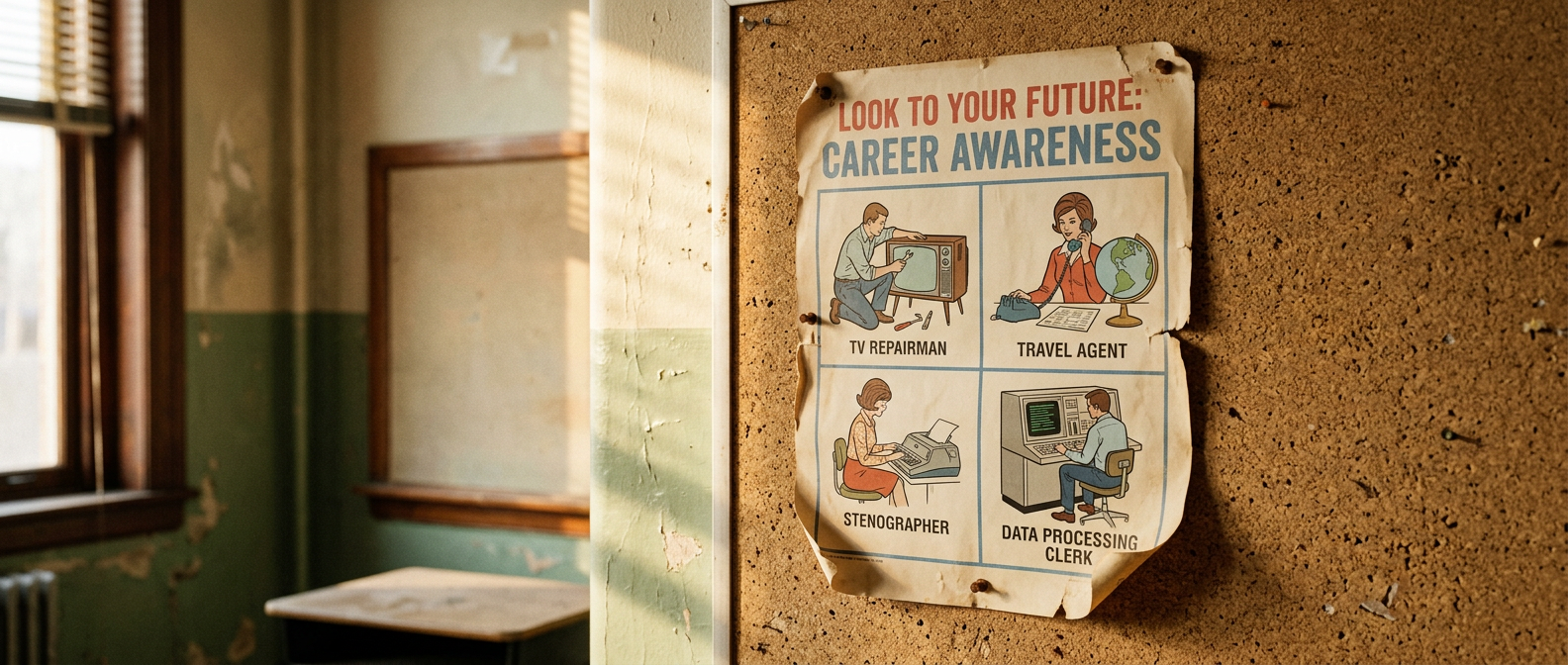
The story we tell about skilled work is one we wrote generations ago.
The industries that are rewriting it.
The industries that run on skilled work are worried about the same thing parents are, and many of us are parents. Kids live online. The capabilities we took for granted growing up — working with our hands, showing up, working alongside people we didn't pick, falling, and getting back up — are not being taught, and most kids are not volunteering for them.
Meanwhile every recruiting campaign our industries run tells a story parents already know: skilled jobs are good, and they lead to rewarding careers. Sixty-eight percent of American parents now say career and technical schools are the equal of a four-year college. Fewer than one in five expect their own child to take that path. We won the argument we were making. It answered a question parents weren't asking.
What parents needed to know is what the work demands of the person who does it, and what those demands give back. Skilled work is physics, chemistry, and mathematics applied under conditions where being wrong has consequences. CTE is where that is learned, and what it requires — hands on the material, being wrong in front of people, showing up, a crew, judgment, a finished piece — is what school, society, and screens have taken from this generation. We would be glad to hire these students. They need this whether they ever work for us or not.
Why associations, and only associations.
A company, however large, speaks for itself. A trade association speaks for an entire industry. Everything here rests on that difference.
When a coalition of associations says CTE is applied science, the claim is about an education, not an opening. It can document the claim, because the industries themselves can vouch for the record, occupation by occupation, in one place. And it can say it upstream of every recruiting program, to families while the child is still in school and the choice is still open.
The CTE Science Project is that coalition. Its partners are the associations that fund it and decide where it goes.
What partners do.
At launch, the partners will say something national trade associations have never said together: that CTE is applied science, and that this generation needs what it demands. It is a statement about children, not about hiring, from the industries least expected to make it — and it puts those industries in the conversation parents are already having.
Partners direct the work: which occupations the Project maps, which communities the CTE Science Teach-In reaches, and how the story is told. Each partner brings its own classroom material and gets back a program to carry it — a Teach-In in its industry, taught by high school CTE students, with the local news coverage the Teach-In earns campaign after campaign — and its lessons join the CTE Science Lesson Library, where any teacher can find them. Each industry holds one seat. There is no board above the partners; they are the coalition.
The Advisory Board.
Alongside the partners sits an Advisory Board of educators and practitioners who serve as individuals — teachers, principals, career and technical education leaders, employers who have done this work in their own communities, and the people who built the Teach-In's predecessor. They hold no vote and no financial stake. Their job is to keep the Project honest about what works in a classroom, and to review every lesson before it enters the Library.
Learn more.
We are in conversation with a small number of prospective partners. If your association is worried about this generation the way we are, we would welcome the chance to talk.